“But Sara, why would patients want to do research on themselves anyway? Isn’t it better if you all just give your data to a proper researcher?”
I think that those who know me will agree that I am not often lost for words. However, when the question above was posed to me, I can definitely say that I didn’t know what to say for, what at least felt like, a really long time.
It is a truth universally acknowledged that many patients no longer settle for contributing to medical research only as participants in research studies. Over the last decade or so, patients have increasingly made their voices heard in all nooks and crannies of the research process. Some of my favourite examples include:
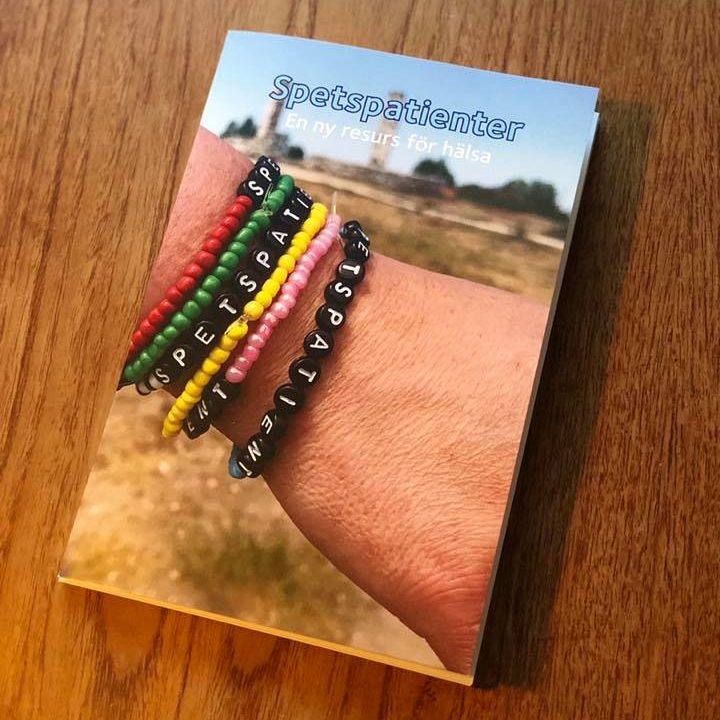
The report “Spetspatienter – en ny resurs för hälsa” (only in Swedish I’m afraid)
My non-Swedish speaking friends may have been wondering what I have been up to lately. And it’s a fair question, since I haven’t been blogging much in English for a while. For the last two years or so, I have been leading a project aiming to change the perception of patients, both among healthcare professionals and similar but also change how we patients see ourselves and our roles in our own health and care. The project is called: “Spetspatienter – en ny resurs för hälsa” (or in English: “Lead Patients – a new resource for health”) and it is funded by the project partners and Vinnova, which is the Swedish Governmental Agency for Innovation Systems. (more…)
Jag utsågs av nyhetsmagasinet Fokus i januari 2019 till årets medicinsvensk 2018 med följande motivering:
Att vara patient kan vara detsamma som att känna sig maktlös. Men så behöver det inte vara. Årets medicinsvensk är civilingenjör i kemi och doktorand i hälsoinformatik. Hon använder sin kunskap för att sätta makt i händerna på patienter, inklusive sig själv i sin roll som Parkinsondrabbad. Med hjälp av konkreta och praktiska metoder för att informera sig om och hantera sin hälsa utbildar hon “spetspatienter”, som inte blint lägger sitt öde i sjukvårdens händer.
Karolinska Institutet, LIME about the award (in English)
Sara Riggare appointed “Swede of the year in medicine” by Fokus Magazine!
Fokus Magazine’s award ‘Swede of the year 2018’ goes to a person who has distinguished him- or herself and contributed to making Sweden change for the better.
The motivation of the jury was announced at the prize ceremony held on January 30, 2019 in Stockholm:
“Being a patient can often mean feeling powerless. But it doesn’t have to. This year’s ‘Swede of the year in medicine’ holds a Master of science in chemical engineering and is a doctoral student in health informatics. She uses her knowledge to give patients power, including herself, as a Parkinson sufferer. Using concrete and practical methods to get informed about and manage her own health, she also educates ‘lead patients’. They, like her, don’t blindly put their fate into healthcare’s hands.”
“I am very happy and proud to have been given this award. To me it is a sign that the role of the patient is changing, which is very good”, says an overwhelmed Sara Riggare.
Sara Riggare, PhD student at Department of Learning, Informatics, Management and Ethics (LIME) at Karolinska Institutet, is an expert on her own illness. She believes that patients need to be more involved in their own treatment to improve their own healthcare experience.
“I would like to help other patients and equip them with the knowledge I did not have to start with but have acquired over time. I hope that my research can change things for me and for the rest of the world. That’s what I do every day and hope to be able to continue doing”, says Sara.
Warm congratulations to Sara for this great honor.
My new friend Potemkin meets my furry friend Shiva
Tuesday last week, I got myself a new friend. I have namned him Potemkin and you can see him in the photo here, being examined by another good friend of mine, Shiva the cat. We had no idea what a suitable name we gave him, he really is a “god of destruction”. Just come to our place in the countryside in the summer to witness the carnage for yourself.
But I digress, this post is about my new rolling friend Potemkin.
In this post I will use the Swedish word for a mobility aid with 4 wheels intended for providing support when walking, which is “rollator”. (more…)
A few days ago, I had some disappointing news. I have been working on my PhD in the area of digital selfcare and self-tracking in Parkinson’s disease since 2012, which is probably starting to be a bit too long. I was therefore very happy to be able to submit my application to defend my thesis before the university went on summer holiday. In the application I aimed for thesis defense in late November, the examinators and the opponent had confirmed their availability and I was starting to look forward to D-day. Of course I was well aware of the potential obstacles that were left to clear. The vetting of an application to defend a doctoral thesis at my university entails two separate parts. The first part checks things like that any of the supervisors (current or previous) have not published anything with any of the examiners or the opponent and that the scientific articles that the applicant wants to include in her thesis are of sufficient quality and extent to be equivalent to at least four years full time work. The main supervisor also submits her statement of the doctoral student’s learning process and development during her time as a doctoral student. The second part of the vetting is dedicated to ethical aspects.
One of my containers for my morning doses with one morning dose laid out.
Every morning I have my phone alarm set to ring at 6 am. Every morning, weekday or weekend, workday or holiday, because at 6 am I take my first dose of medication. I take six different pills for my Parkinson’s disease, one to make up for not having a thyroid and one contraceptive. I prepare my morning doses a few weeks at a time in containers with one compartment for each day of the week (see photo) and keep next to my bed together with a bottle of water. That way I can take my meds while still in bed and more often than not, I will go back to sleep for a while longer before getting up. This way the meds will have kicked in when I rise and moving will be a bit less difficult. (more…)
Today I learnt that Tom Isaacs, President and co-founder of the Cure Parkinson’s Trust died very suddenly and unexpectedly yesterday morning. Tom is (yes, he still is) one of the most well-known PwP (people with Parkinson’s) in the world and has contributed so much to the global PD community. The world has lost an amazing leader and trail-blazer of the inclusion of patients’ voices on every level of PD research and I have lost a friend, role-model and mentor. (more…)




 Today I learnt that Tom Isaacs, President and co-founder of the Cure Parkinson’s Trust died very suddenly and unexpectedly yesterday morning. Tom is (yes, he still is) one of the most well-known PwP (people with Parkinson’s) in the world and has contributed so much to the global PD community. The world has lost an amazing leader and trail-blazer of the inclusion of patients’ voices on every level of PD research and I have lost a friend, role-model and mentor.
