
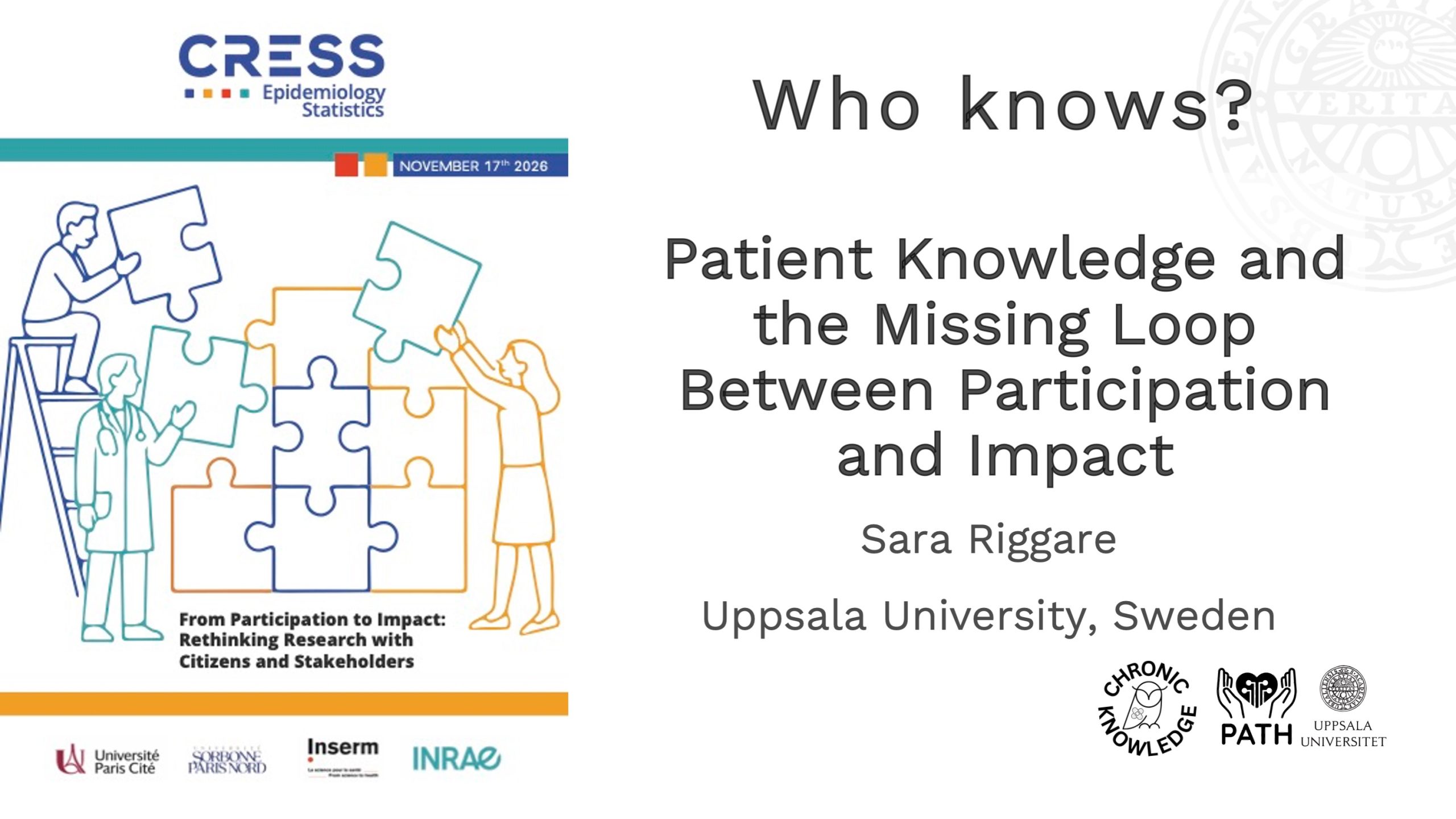
Yesterday, a keynote I had prerecorded was shown at the CRESS Annual Symposium in Paris. This year’s theme was From Participation to Impact: Rethinking Research with Citizens and Stakeholders. My keynote recording is now available below.
The talk starts four hundred years ago in Padua. The physician Sanctorius spent around thirty years weighing himself in a chair that hung from the ceiling. He was trying to make an invisible phenomenon appear: the weight the body loses without anyone seeing it go. The word phenomenon means “that which appears”, and something can only appear if someone is looking.
In most citizen science, the phenomenon is out in the world: birds, water quality, galaxies. In citizen science for health, it usually lives in the citizen. I spend about one hour a year in neurological care for my Parkinson’s disease. The other 8,765 hours, I manage it myself. So who knows?
I go through the four phases of the personal science cycle (questioning, observing, reasoning and explaining) and ask the same thing at each one: who does it, and whose knowledge counts? Along the way I draw on our review of epistemic agency in self-tracking, the Chronic Knowledge project and meta-selfcare, learning circles for people with Parkinson’s, patients’ use of AI, and Dana Lewis’s work on why so little of what patient researchers know ever reaches the research literature.
My argument is that the gap between participation and impact is mainly an epistemological problem. It is about whose knowledge research is designed to receive and whose knowledge research is designed to increase.
At the end of the talk I offer five questions for your next research project, one for each phase of the cycle plus one about closing the loop. The last one asks how contributors will learn what you did with their input, and whether that is in the budget.
The talk is about 34 minutes long. I’d love to hear what you think.
Leave a Reply